


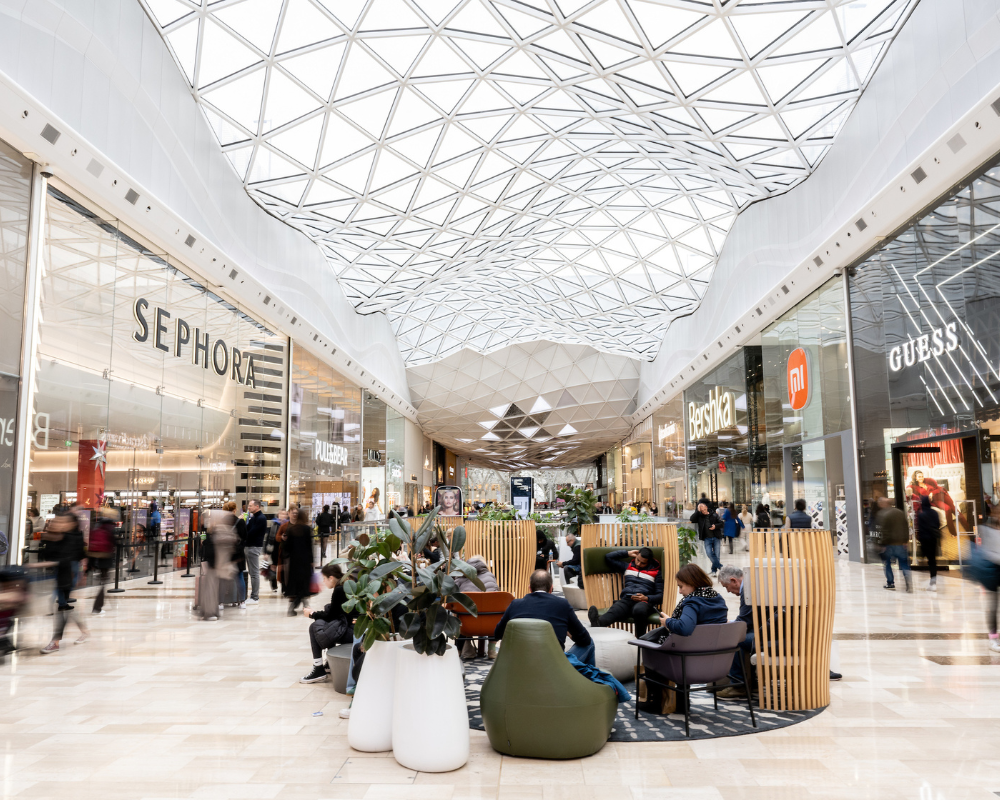
Retail brands face constant scrutiny on sustainability. But the landlords behind shopping centres, who control which tenants get space, have largely stayed out of the spotlight. There are signals that’s starting to change, including the newly announced Sustainable Retail Index Association.
An overlooked power player in sustainability
Consumer brands typically bear the brunt of scrutiny on sustainability; they do make and sell our goods, after all. But how often does the industry turn this lens onto retail landlords, those behind-the-scenes companies owning the mega-malls, high streets, and shopping precincts? Should we not demand the same level of commitment to Environmental, Social, and Governance (ESG) issues from landlords, as well?
Undoubtedly, landlords play a driving role in how retail spaces are curated. They control the brand mix and directly shape the IRL shopping experience. They can influence business decisions from the brands they lease to (i.e., tenants), nudging shoppers towards what the industry terms more “responsible” consumption. Yet they’re an often unseen player.
This week, however, a new initiative launches that begins to address this missing link. The Sustainable Retail Index Association, co-founded by two of the world’s largest retail landlords—Unibail-Rodamco-Westfield (URW) and Ingka Centres, IKEA’s parent group—aims to give landlords a standardised way to measure the sustainability performance of their tenant portfolios. Full disclosure: Yes, Good On You is the data partner behind the index. I recently spoke with co-founder Sandra Capponi to understand how she and her team worked to ensure the Index is based on reliable, transparent, and publicly available information.
The Sustainable Retail Index Association launch is one signal that despite corporate backsliding, there’s a growing focus on the role of landlords.
The Association launch is one signal that despite corporate backsliding, there’s a growing focus on the role of landlords. Some retail players are taking stock of their impact and the ESG credentials of their tenants. Others are rethinking shopping centres and retail environments as venues for repair, recommerce, recycling, and closed-loop services.
Can retail go from shrines to consumerism to hubs of education and circularity? The next generation of retail spaces emerging from this moment show real potential to shift consumer behaviour. But only if the momentum continues to build.
Physical retail still dominates how we shop
While online shopping has boomed in the last 10 years, physical retail is still the leading shopping touchpoint globally—in 2024, almost 73% of UK retail sales were done in physical stores. In the US, while e-commerce sales are expected to reach $1.6 trillion in 2028, that will still only be 24% of the total retail sales, according to Forrester research.
“This is a huge, powerful industry,” says Sandra Capponi, co-founder of Good On You. “It has significant influence over which brands consumers can access, but it’s largely been left out of the sustainability conversation. The more I’ve investigated this space, the clearer it’s become that landlords have both the commercial incentive and the structural power to influence retailer behaviour.”
The Index itself is an assessment tool that combines Good On You’s brand rating data with in-store practices—everything from the brand’s value chain through to whether it offers circularity services in its stores.
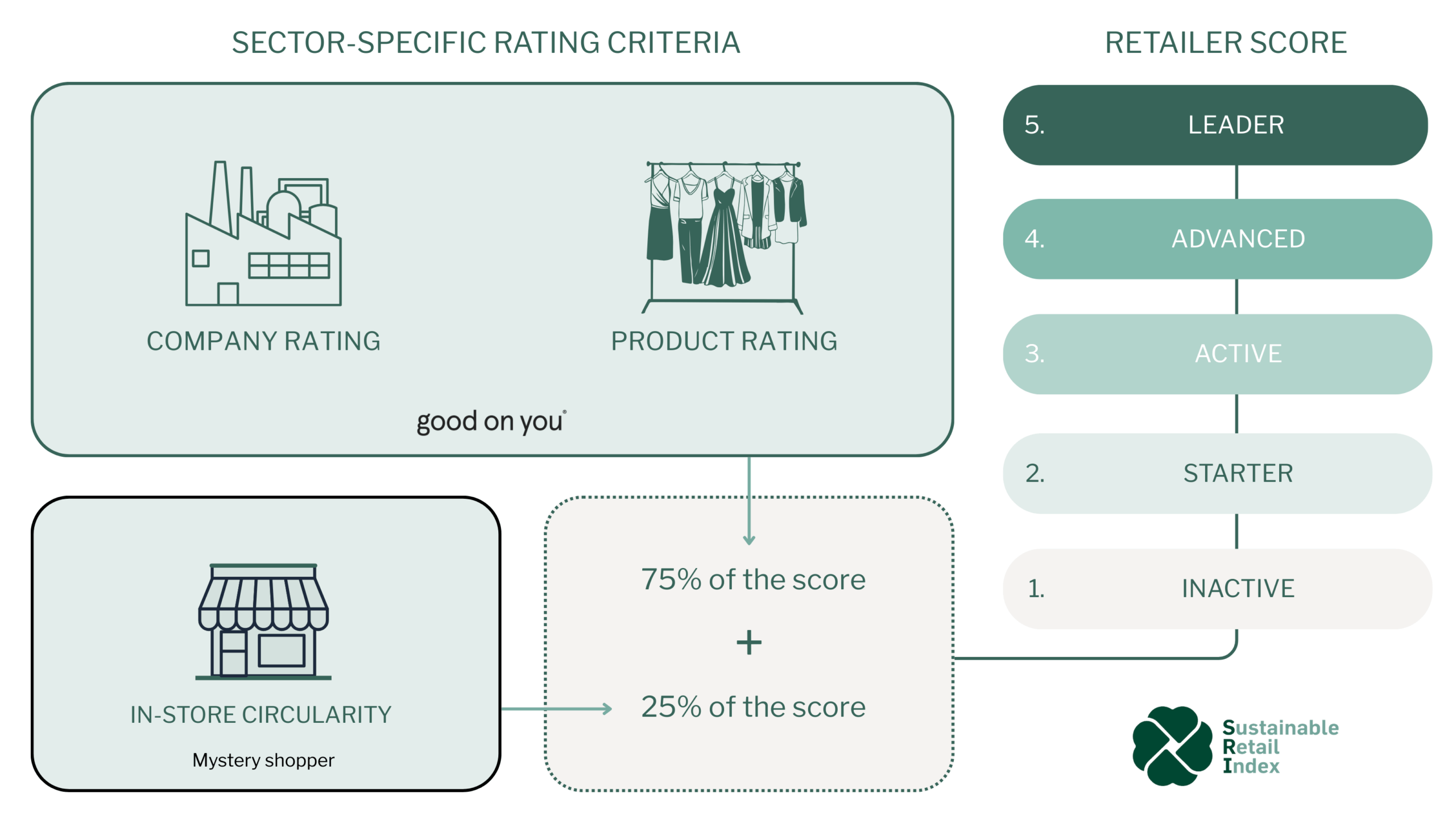
This infographic, from the Sustainable Retail Index Association, shows how it works.
Good On You first developed the Index in collaboration with URW; the new Association exists to make it an industry standard.
It launches at a time when a growing number of landlords want granular data on their tenants, from major retailers to independent labels, so they can identify hotspots and address them at the store and shopping centre level.
Reimagining retail’s role
“We are convinced that there is a role to play for landlords to engage with retailers,” says Anna Drozdowski, global head of sustainable retail and social impact for URW.“It’s about how we can support tenants on ESG diagnosis and improvement with dedicated tools.” One tool is, of course, the Sustainable Retail Index itself.
But that’s not the only thing landlords and multibrand retailers are doing to reimagine physical retail’s role in the value chain.
There is a wide variety of initiatives that shopping destinations can adopt, both in partnership with retailers and independently. In-store upgrades can include everything from removing plastic bags and introducing refill stations for beauty products to ensuring efficient waste and recycling systems or energy-efficient lighting.
In-store upgrades can include everything from removing plastic bags and introducing refill stations for beauty products to ensuring efficient waste and recycling systems or energy-efficient lighting.
URW is integrating circularity by working with tenants to introduce rental, resale, and repair services, as well as bringing in companies such as Sojo, a next-gen alterations platform, which has launched in both London and Paris Westfield centres. “[Sojo] offers a new way of repairing because it’s an omni-channel offer that is both online and on-site,” explains Drozdowski.
“The intention behind it was to ask, how can we play our role to support retailers in offering services that maybe they can’t do themselves for different reasons?”
Similarly, multi-brand retailer Percy Langley, which stocks only British brands across a handful of retail locations around the UK, also considers its stores to be multi-purpose spaces to connect with its community.
“Our retail spaces are critical for us as event spaces,” explains Poppy Sherbrooke, founder of the cool Britannia retailer Percy Langley. “We’ve done things like repair workshops with our designers showcasing visible repair so that you’re able to learn techniques. We have one of our upcycling brands coming in to make Christmas decorations out of textile waste in the run up to Christmas, and doing workshops where, even if you’re not seeking to buy new clothes, you can still engage with the design community.”
There’s a clear business case for action
Initiatives like the Sustainable Retail Index Association could eventually guide retail landlords in how they curate the brand mix for each location, selecting tenants that tick crucial ESG boxes as well as matching the location’s demographic.
“Landlords like URW and Ingka Centres are taking action to improve the mix of retailers and tenants for a few reasons,” explains Good On You’s Capponi. “So they can manage risk in their supply chain and their customer base, so that they can give shoppers better options, and so they can engage other stakeholders that are asking for this information, including investors.”
If ever there was an incentive for landlords to think about the sustainability impacts of their locations, it’s to meet the expectations of ESG-focused investors. 88% of investors globally are interested in investing in companies that achieve both financial and ESG linked returns, according to research from Morgan Stanley. While political backlash against ESG has dominated US headlines, institutional investors, particularly in Europe, continue to ask hard questions about climate risk and supply chain ethics. Retail landlords that can demonstrate portfolio-level sustainability data have a story to tell.
88% of investors globally are interested in investing in companies that achieve both financial and ESG linked returns.
“There are shareholders and potential investors asking landlords about how they are derisking their portfolio, and how they are tackling sustainability is definitely a driver,” says Capponi. “It’s an important one, because it’s not just a moral obligation; it’s commercial too. At many levels, there’s an appetite for shopping centres to do more.”
There’s a huge opportunity to appeal to a more conscious consumer base, one that is interested and engaged, but needs support to make more considered shopping choices. “We’re not here to necessarily dictate what is right or wrong, we are here to help customers make informed decisions,” says Sherbrooke of Percy Langley. “Informed decision-making at a customer level is one of the most powerful tools we have in society to sway the influence of these big corporations.”
The persistent gap between shoppers’ stated values (they say they want to buy more sustainably), and actual purchasing behaviour (in practice, they don’t) is often blamed on access. Zalando’s 2025 research found that after price, the biggest barriers include difficulty identifying sustainable options, not knowing where to find them, and general confusion about what sustainability even means. Physical retail spaces could, in theory, solve for this if landlords curate offerings that make better choices easier to find.
“People expect retailers, landlords and shopping centre owners behind the scenes to be doing more and to take accountability for their actions,” says Capponi. “They don’t want to be in places that are just promoting the same old fast fashion; they want variety and options to make better decisions. And if landlords want to drive foot traffic for their retailers, they need to create a better, more diverse offering.”
People don't want to be in places that are just promoting the same old fast fashion; they want variety and options to make better decisions. And if landlords want to drive foot traffic for their retailers, they need to create a better, more diverse offering.
Sandra Capponi – co-founder of Good On You
As a vital link between a fashion brand and its customers, physical shopping centres can be a powerful force of influence to drive more responsible practices from the brands they lease stores to. Those taking a more ambitious approach can look beyond the in-store experience to how these spaces can educate shoppers, enable new ways of engaging with their clothes and other products, and be destinations for experiences that truly shift the needle and close the attitude/behaviour gap. “I see so much potential for some big changes,” says Sherbrooke. “The scale that these businesses are working at gives them so much scope and power to make significant change very quickly.”
Whether these initiatives translate into measurable accountability hinges on the current momentum being sustained over the longer term. But as retail landlords begin treating sustainability as a portfolio-level concern, not only a marketing opportunity, the fact that we’re having an industry-wide conversation is a promising start.



![textile scraps symbolising the textile to textile recycling industry]](https://goodonyou.eco/wp-content/uploads/2026/07/textile-scraps-symbolising-the-textile-to-textile-recycling-industry.jpg)