
Do we need a new term to differentiate plant fibres that can be wool alternatives? As PETA wraps up its first-ever Plant Wool Month, we invited a campaigner there to make the case for the new label, which brands may use to highlight alternatives that aren’t synthetic.
Wool: either made from animals, or replicated with petroleum-derived synthetics. Right? Not so fast. Some of the cosiest knits, sharpest suits, and warmest winterwear can be made from plant-derived fibres. This November, PETA launched its first-ever Plant Wool Month, a 30-day global celebration of the hardworking crop farmers, innovative textile manufacturers, and designers who spin animal-free, plant-based yarns.
The term “plant wool” was coined by PETA and we view it in much the same way as plant-based leather. Leather alternatives don’t need to be plastic—they can today also be made from fibres such as cactus, corn, apples, mushrooms, and more. Similarly, wool alternatives can be created with animal-free textiles that come from plants.
The campaign celebrates all the materials that come from the Earth itself and that are able to replace the use of animal fleece in fashion, and highlights PETA’s 100% Plant Wool logo which brands can apply to use free of charge to proudly display their cruelty-free, plant-derived designs.
The term 'plant wool' was coined by PETA and we view it in much the same way as plant-based leather.
Why is PETA focusing on this now? Undercover investigations have shown rampant and routine abuse of animals in the wool industry, which a lot of fashion consumers don’t know about. Kicking, beating, stomping, and mutilating the animals are the rule rather than the exception in the wool industry, where the animals’ welfare takes a backseat as profit becomes priority.
Farming sheep for wool isn’t only problematic because of cruelty. The wool industry has long invested in advertising to promote sustainability claims, but the evidence shows that, like all animal-derived products, wool has a substantial and detrimental environmental impact. Sheep emit large quantities of the potent atmosphere-warming greenhouse gas methane, require resource-intensive feed and water, and are treated with an anti-parasite treatment that’s highly toxic.
So, what are plant wools? There are a lot more options than you might think. For us at PETA, a plant wool is a yarn or textile that is plant-derived. This can mean a 100% cotton sweater, a hemp-based suit, or a eucalyptus yarn used for knitting. But the term can also be used to describe a treated material such as Tencel Lyocell or some bamboo-derived materials. As long as the yarn or textile is exclusively made from plants (as opposed to synthetics or animals), it can be considered a plant wool.
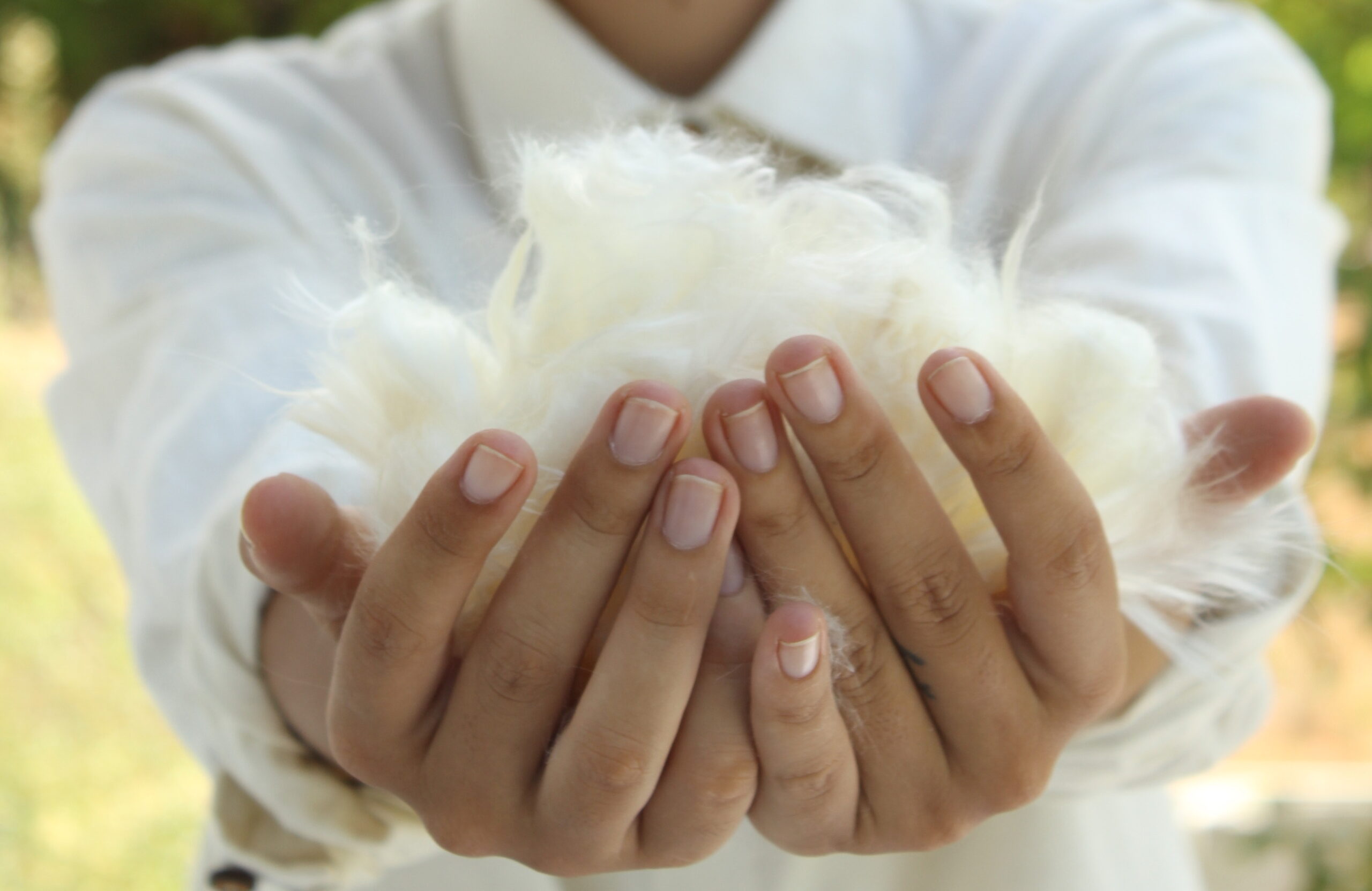
A few fibres PETA categorises as ‘plant wool’
What, according to PETA, counts as a plant wool? Here are a few fibres that would get the label—a mix of popular and well-known textiles such as cotton and hemp—both of which are widely available today. We also bring in a few new and niche materials that fashion is experimenting with.
- Organic cotton: it can be warming and cozy, too, and brushed to mimic fleece.
- Hemp: hemp is hypoallergenic, biodegradable, and has a significantly lower carbon footprint and water consumption compared to sheep’s wool. Hemp also sequesters more CO2 than it emits.
- Tencel: This material, developed by the Lenzing company, is made with wood-pulp cellulose: Tencel Lyocell derives from eucalyptus, whereas Tencel Modal is made from beechwood.
- Banana fibre: Material innovation company Bananatex has won a PETA Fashion Award for its sturdy, high-tech textile made from Abacá banana plants. This material can be used similarly to polyester, and can contribute to replacing this synthetic fibre in vegan knit alternatives to wool. Bananatex’s full range is now vegan.
- Soybean cashmere: The versatile soybean can be repurposed to create a drapey, silky textile that can be fully biodegradable. It’s moisture-wicking and hypoallergenic, too.
- Nettle: London Fashion Week favourites VIN + OMI are no strangers to material innovation, so when the brand paraded designs made from waste nettles from the royal Highgrove estate on its runway, fashionistas’ curiosity was piqued. Nettle fabric offers the luxurious feel of silk and the softness of cashmere. It’s also biodegradable.
- Seaweed: London-based Leticia Credidio is one forward-thinking designer who has used SeaCell, a seaweed-derived fibre made by Smartfiber, in her clothing and loungewear. It uses the same closed-loop system as Tencel Lyocell, which prevents the release of solvents into the environment.
- Bamboo: This fast-growing plant regenerates quickly, is renewable, and requires minimal pesticides and fertilisers. Luxuriously soft, warm and breathable bamboo-derived fibres are already a staple in activewear, but this versatile fibre can also be a wool alternative.
- Kapok: Kapok fibre comes from the kapok or ceiba tree, which grows in Southeast Asia. It offers a soft, silky feel combined with a fluffy texture. As a yarn, kapok is not used alone but rather blended with other fibres to bring additional warmth, flexibility, and anti-moth properties.
- Milkweed: The milkweed, or Calotropis plant, is native to North America and India. Its feathery seed fibres can be used to create a lightweight material with excellent thermal regulation. One brand working on innovations with milkweed plants is Faborg, the company behind Weganool—winner of a PETA Fashion Award. This versatile yarn is made by spinning milkweed fibre and rain-fed cotton together to produce an incredibly soft yet remarkably strong yarn.